
July 6, 2026
By Emma Brown, Education Advisor at Renaissance
Getting students to engage with reading has never felt more challenging, yet the impact of strong literacy skills has never been more important. With reading for pleasure in schools on the decline and classrooms becoming increasingly diverse, educators are being asked to do more with less. So how can schools improve student literacy in a way that is both effective and sustainable? Emma Brown and Charlotte Sloan, Education Advisors at Renaissance explore a simple, practical framework designed to boost student reading engagement, support EAL learners and guide smarter book selections, helping teachers create accessible, engaging and meaningful reading experiences for every student.
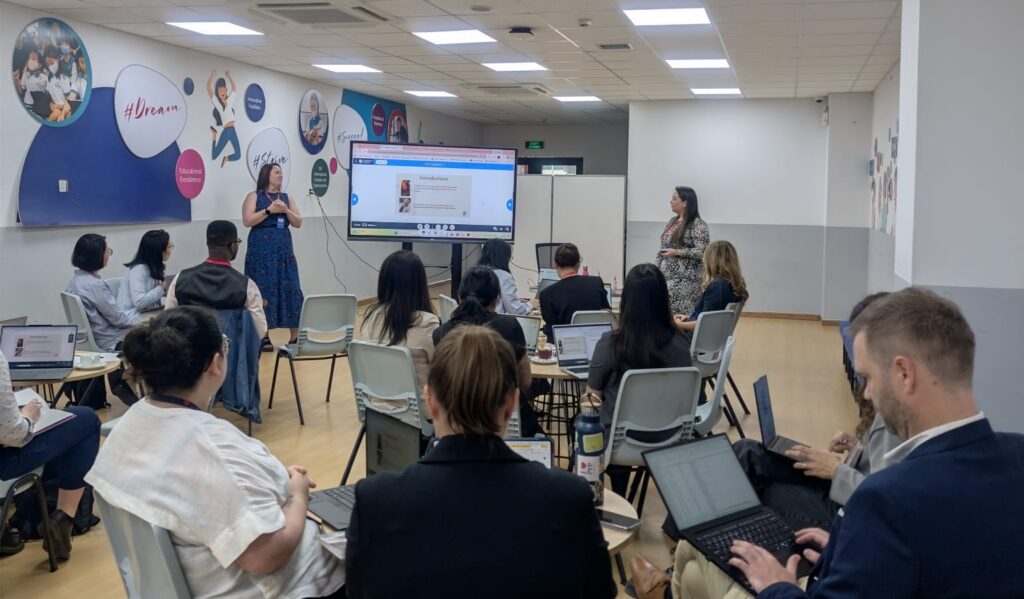
‘Why does my brain seem to only function in the middle of the night?’ The message pinged when I opened my laptop to a proposal from my fellow Education Advisor, Charlotte Sloan. Charlotte and I were preparing to deliver a series of workshops in Vietnam and Thailand, and this simple acronym she came up with at 23:58 and had to write down became the centre of our session plan.
‘Do you like it or does it feel a bit primary school level?’, she asked tentatively. My immediate response was: the simpler the better.
We knew we wanted to talk about student reading engagement and improving student literacy, but we didn’t want to add more weight to teachers’ already busy workloads. That said, reading for pleasure in schools is declining. Renaissance’s What Kids Are Reading report showed that in 2024 only 34.6 percent of students in the UK said they read for pleasure.
This challenge is not unique to the UK. Educators across international school settings are asking the same question: ‘How do we get students to read?’
Introducing the R.E.A.D framework
With experience as teachers, we approached this challenge with practicality in mind. Rather than reinventing the wheel, the R.E.A.D framework provides a clear, actionable way to support your literacy strategy. It helps leadership teams identify specific opportunities for improving student literacy across diverse international contexts.
The framework stands for:
- R – Right challenge
- E – Engaging
- A – Accessible
- D – Diverse
This structure allows you to evaluate your resources and teaching strategies systematically and identify opportunities to improve student reading engagement.
R – Right challenge: Supporting reading levels and assessment
Understanding a student’s current reading ability is a foundational step in any successful literacy strategy. Especially in an international school setting, where a student’s conversational English might outpace their reading comprehension, accurate assessment is essential.
To solve this, schools must implement reliable, data-driven assessment tools. Tools like Renaissance Star Assessments provide educators with a clear Zone of Proximal Development (ZPD) for each student, highlighting the precise reading level where optimal learning occurs. By giving teachers actionable data, schools can match students with texts at the right level, reducing guesswork, streamlining effective book selection and monitoring progress efficiently.
Many teachers were surprised to discover how difficult it can be to judge readability accurately. Even familiar texts can vary widely in complexity.
However, reading levels alone are not enough. A book may be technically appropriate but fail to engage a student due to its content. This led us naturally to the next part of the framework.
E – Engaging: Encouraging reading for pleasure
Improving reading for pleasure in schools starts with understanding what students actually want to read. In academic environments, there can be a tendency to push classic literature over contemporary or high-interest texts. However, to build lifelong reading habits, engagement must come first.
During our sessions, teachers noted that their students gravitate toward graphic novels, comics, or non-fiction texts about their specific interests over traditional texts. The evidence supports this preference: students who read graphic novels are significantly more likely to report enjoying reading.
To support student reading engagement, educators may need to rethink what counts as reading. Graphic novels, high interest texts and contemporary titles can play a powerful role in re-engaging reluctant readers.
This is where a structured reading management system proves invaluable. Renaissance Accelerated Reader guides students to books that are most likely to catch their interest. Upon finishing a book, readers take a quiz to monitor their comprehension. The quiz gives them instant feedback to help them progress.
Using insights from the What Kids Are Reading Report can also help schools make informed book selections for students, aligning content with real student preferences rather than assumptions.
A – Accessible: EAL reading support and inclusive literacy
Accessibility is a key factor in improving student literacy, particularly in diverse and international classrooms.
Barriers to reading can affect many students, including those with limited access to books, speech and language needs, or those learning English as an additional language (EAL). Effective EAL reading support requires a proactive approach. Instead of waiting for a student to struggle with a complex text, educators must identify potential linguistic barriers in advance.
Providing accessible reading materials, scaffolding vocabulary and adapting content ensures that all learners can participate meaningfully. When school literacy programmes prioritise accessibility, they build confidence in their EAL students. This structured support ensures students aren’t penalised for their developing language skills, allowing them to access the curriculum alongside their peers.
D – Diverse: Creating inclusive international school literacy programmes
The final element of the framework focused on diversity in literature. Drawing on Rudine Sims Bishop’s concept of Mirrors, Windows and Sliding Glass Doors, we explored how literature should reflect a student’s own experiences (mirrors) while introducing them to new, global perspectives (windows).
For many schools, particularly those delivering international school literacy programmes, the key gap identified was a lack of ‘mirrors’ in their collections.
Ensuring diversity in book selections for students helps foster belonging and increases engagement. When students see themselves and their cultures reflected in their reading materials, their connection to the text deepens, supporting both reading enjoyment and attainment.
A simple way to improve student literacy
We ended each of our sessions with a reflective question: If an external visitor reviewed your reading provision, which part of R.E.A.D would be least visible?
This question helped educators identify practical next steps to strengthen their approach to student reading engagement and improving student literacy.
The feedback we received reinforced the value of simplicity:
- A quick and easy way to rethink our reading approach
- Actionable takeaways
- Practical and accessible framework.
That was always the goal. Not to add complexity, but to provide clear and effective literacy strategies for teachers that can be implemented immediately.
Supporting reading in a changing world
Reading behaviours are evolving, shaped by digital habits and changing student preferences. Supporting reading for pleasure in schools and ensuring access to accessible reading materials requires flexibility, insight and a willingness to adapt.
The R.E.A.D framework offers a simple starting point:
- Right challenge: Eliminate guesswork by utilising precise assessment tools.
- Engaging: Prioritise high-interest materials to foster reading engagement.
- Accessible: Proactively remove barriers through accessibility.
- Diverse: Ensure your library reflects the rich cultural backgrounds of your students.
For schools looking to strengthen their literacy provision, especially within international school literacy programmes or with a focus on EAL reading support, this framework provides a practical, sustainable and structured approach.
Sometimes, improving literacy does not start with something new. It starts with seeing what is already there more clearly.
